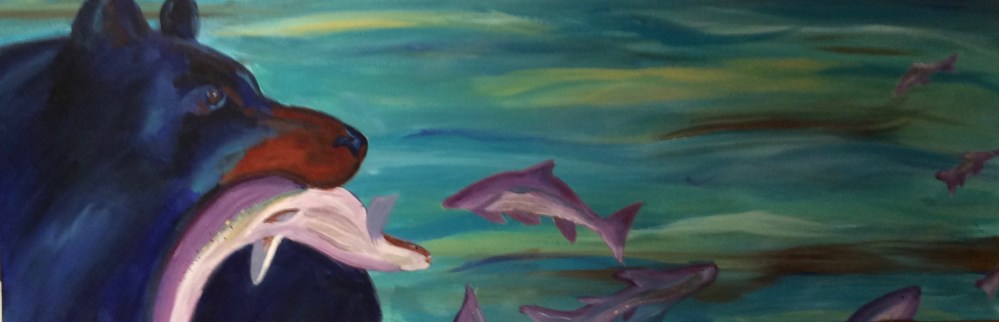
Painting Title: What Goes Around Comes Around
I have spent the past week writing about the exploration of western North America by white colonists and the impact that various laws, economic changes, politics, and media had on our perception of the indigenous people who lived here. I’ve also spent some time reading (for pleasure) The Book of Forgiving by Desmond and Mpho Tutu. I was in the middle of writing about reconciliation when it was time for my 13 year old step-son to have breakfast.
Yesterday, I asked my husband to let my step-son know that he had spilled honey on the kitchen floor the night before. When I sat down at the kitchen counter to have lunch, I stepped in the honey, which transferred to my slippers, to more parts of the floor, and to the chair. As a consequence, I had a lot of clean-up to do. Since I didn’t receive an acknowledgement, I didn’t know if the discussion had occurred and so I asked my step-son about it. He agreed that his father had mentioned it to him. We were having a good conversation and so I started to explain the benefits of apology, when we were interrupted by his father walking in the house. Since I know that his father would think the conversation was unnecessary, I stopped talking.
The origin of my fear for continuing the parenting conversation lies in an argument from a few years prior. At some point, I was told to “let the little things go.” While I don’t think that drips of honey are worth getting angry about, I don’t think we should always “let little things go.” Each time that we share with a child the impact her/his actions have had on those around them, we create opportunities for them to learn empathy. Big or small, the action allows them to see the world from the perspective of others. What might be a little thing to me could be a big thing to someone else.
We can only really know the impact that our behaviour has on others when we listen to their narrative. It is unfair to assume that what is a “little thing” to one person is also a “little thing” to another, whether it be uncleanliness or the presence of a Confederate statue. When children are encouraged to hear another person’s story and apologize for their unwanted impact on others, it instills in them the importance of maintaining good relationships with other people in their lives. It also provides the foundation for them to freely apologize for bigger grievances. They walk away more confident in their ability to negotiate their way through difficult conversations.
Apology sometimes doesn’t happen, but acknowledgement should. One of the main traits of good managers, is an ability to maintain their own values while acknowledging the values of others. I want my step-children to develop strong values of their own and also appreciate the values of others. Acknowledgement lifts the spirits of the acknowledged; it lets them know they have a voice. When I am acknowledged as a step-parent, I am encouraged to continue the good work of supporting my husband and step-children and I feel included in our family.
Apology is created when a deeper understanding is formed. When individuals are able to connect with shared feelings (anger, frustration, sadness, hurt, exasperation), they are able to apologize. An apology says that you understand the experience of the other person, not just that you acknowledge their right to feel that way. It elevates the relationship to a sense of shared humanity and allows us to love.
Yes, accidents happen, but in adult life there are consequences for accidents. Successful adults are accountable; they take responsibility for their actions. As a friend of mine says, “I’m raising adults, not children.”
 Imperfect Shepherd