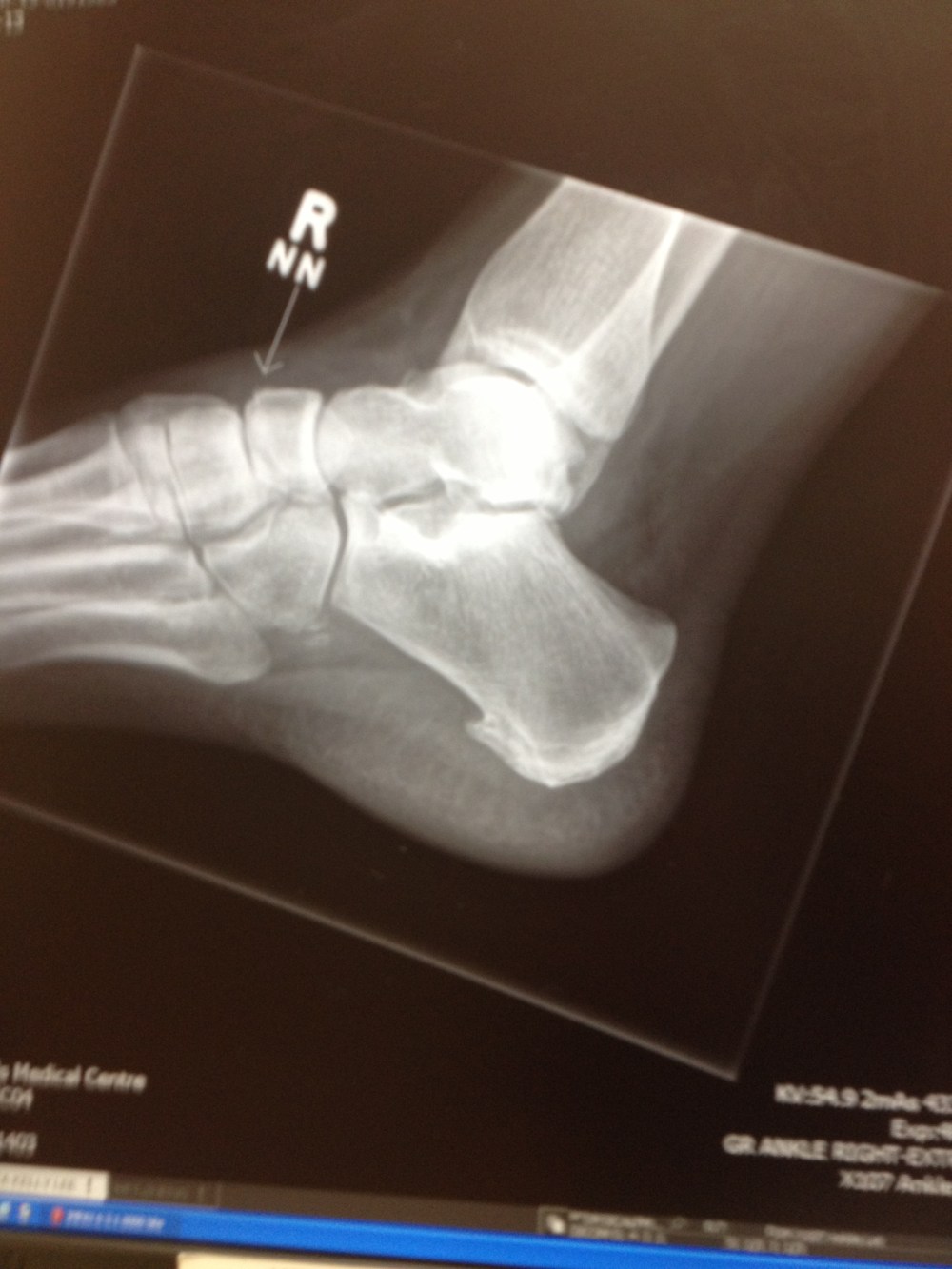
 A few weeks ago, I was out walking my dog with a friend. We had gone fewer than 30 yards when I turned my ankle in a small divot in the ice and fell down, breaking my fibula and tibia in the process. The break required surgery and the placement of a total of one plate and eight screws in my bones. As I lay in the hospital waiting to be mended, I thought about the advancement of technology and how it has transformed my life, for the better and for the worse.
Twenty years ago, I broke my elbow and with a couple of pins was able to get back fairly quickly to riding my bike, even with stiches still in my arm. The ability to support broken bones via external fixation occasionally happened in prehistory. However, drilling a variety of devices into the bones to mend them was rarely a sought after treatment due to the danger of introducing infection, ultimately resulting in amputation. In fact, the common treatment for compound fractures during the American Civil War was amputation, because infection rate was so high due to the poor conditions of war, transport, and care. Even today, the risk of infection resulting from operative procedures is increasing due to the high incidence of staph infections in hospitals and the bacterial resistance of infectious agents.
Despite the use of external fixation, injuries to the leg are more immobilizing. Because the leg supports the full weight of your body, severe injuries require non-weight-bearing use of the leg even with support, for 6-8 weeks. Nevertheless, technology has changed through the past twenty years and even through my lifetime, making it easier for an injured person to get around.
I thought back to when I was a child and remembered television programs where individuals with broken bones were left in the hospital until they were knitted back together. Typically, from the mid-19thcentury until sometime in the 20thcentury, if you had a broken leg, you were confined to bed for at least 6-8 weeks with your leg placed, elevated, and immobilized in a fracture box.
The knee scooter, which I was able to use at home immediately and at work by the third week, did not exist when I was a child. The added benefit of using a knee scooter is that muscles in the thigh receive exercise, preventing atrophy. In addition to changes in orthopedic technology, there have been dramatic changes to communications. While at home, I could wirelessly connect to the internet, allowing me to provide my class with video lectures and keep on schedule with tests and exams, without needing to sit at a desk with a desktop computer. I also had my friendly “happy chicken” app, which allowed me access to television programs from our service. Even twenty years ago, had that broken elbow been a broken leg, I would have been inconsolable, stuck in my room with nothing to do and pressing myself to withstand 30 minutes of swelling to do even a small work task.
My thoughts really focused, however, on the social expectations and level of care provided by others. Of course, I thought about Leonardo di Caprio’s performance in The Revenant, and how thoroughly dependent his character, Glass, was on the kindness of others. It also made me consider how different my life would have been twenty years ago had the injury been a broken leg.
In the hospital, I was able to call on a nurse to deliver me to the toilet and for hospital staff to provide me with the basic necessities of food and water. The new wing of our hospital is equipped with double rooms, each curtained off person having his/her own TV. I was not allowed to go home until I could accomplish basic tasks such as climbing stairs with crutches, using a walker, and an orthopaedic scooter. Once those criteria were met, I was sent home with instructions to elevate and stay off the leg. Many underlying assumptions go along with that. Our families and friends are expected to provide us with many basic needs.
There was no ice on the hospital stairs. As we were still in the throes of the longest winter we’d experienced in years, I was unable to leave my house without the walk being cleared of snow and ice. Once that was done, I could drive (the break was to my left ankle) and I could shop for small items, but I had to ask my husband to help me stock up on foods so that he could leave for a week away. I also needed help accessing our basement. I returned home the day after my surgery and found myself almost completely dependent on others for my survival, including clean underwear and socks.
The experience made me think further about the history of providing care to those who are physically disabled. As a hunter-gatherer archaeologist, I assumed that the disabled would be either carried in a travois or left to die, but I wondered what parameters of disability were cared for and what weren’t. Di Caprio’s Glass was left to die by his own culture, then saved by a Pawnee man, who tended to his wounds, provided him shelter and food, if only for a short time. I knew that my bioarchaeologist friends were able to account for broken limbs and diseases, but had they considered whether or not these individuals received support?
Typically, evidence of healed injuries, provide us with the knowledge that at least some, if not most individuals suffering broken limbs survive their injuries to die later of another cause, however, there is little evidence to provide us with the knowledge of what that care may have entailed. Instead, bioarchaeologists have begun to consult disease related incidences of immobility as evidence that prehistoric people did indeed provide care to those immobilized by injury or disease.
To my delight, there are several cases of individuals whose immobility is recorded in their bones and for whom care must have been given for a considerable period. Many cases document inferred immobility and resultant care or acceptance of individuals with physical disabilities, but only a handful actually record the progression of care that must have been needed throughout the individual’s lifetime. A young man from Gran Quivira, New Mexico suffered from juvenile arthritis, losing as much as half of his limb mobility before his death (Hawkey 1998). In this case, the bioarchaeologist was able to relate musculoskeletal markers with the progression of the disease and loss of mobility throughout the individual’s lifetime. In the second case from late Jomon Japan, a young individual of unknown sex survived juvenile polio to live to his/her late teens or early 20s (Suzuki et al.). Finally, the most elaborate discussion of care comes from the study of an individual (M9) who lived 3700-4000 years ago in Vietnam (Tilley and Oxenham 2011). The young man, who was disabled from a congenital abnormality resulting in spinal fusion, had lived at least a decade in either a paraplegic or quadriplegic condition, making him dependent on others for basic necessities such as food and water, and also for basic care and safety. In addition to these basic needs, the authors discuss the need to prevent bedsores and fractures from bone demineralization and muscle atrophy. The care discussed includes massage, daily physical manipulation, and a variety of hygienic and emotional supports.
Returning to my own experience, our society has developed support systems for those with long-term physical disabilities and the families of those individuals become accustomed to the needs of their loved ones. However, for those of us with short-term disabilities, there are many assumptions regarding the level of care needed. I don’t hold my family or friends accountable for failure to meet all of my needs. They have busy lives. I was expected to be back at work in two weeks, despite not having the support to leave the house in the heavy snow when no one was home. We are missing something.
 Imperfect Shepherd